


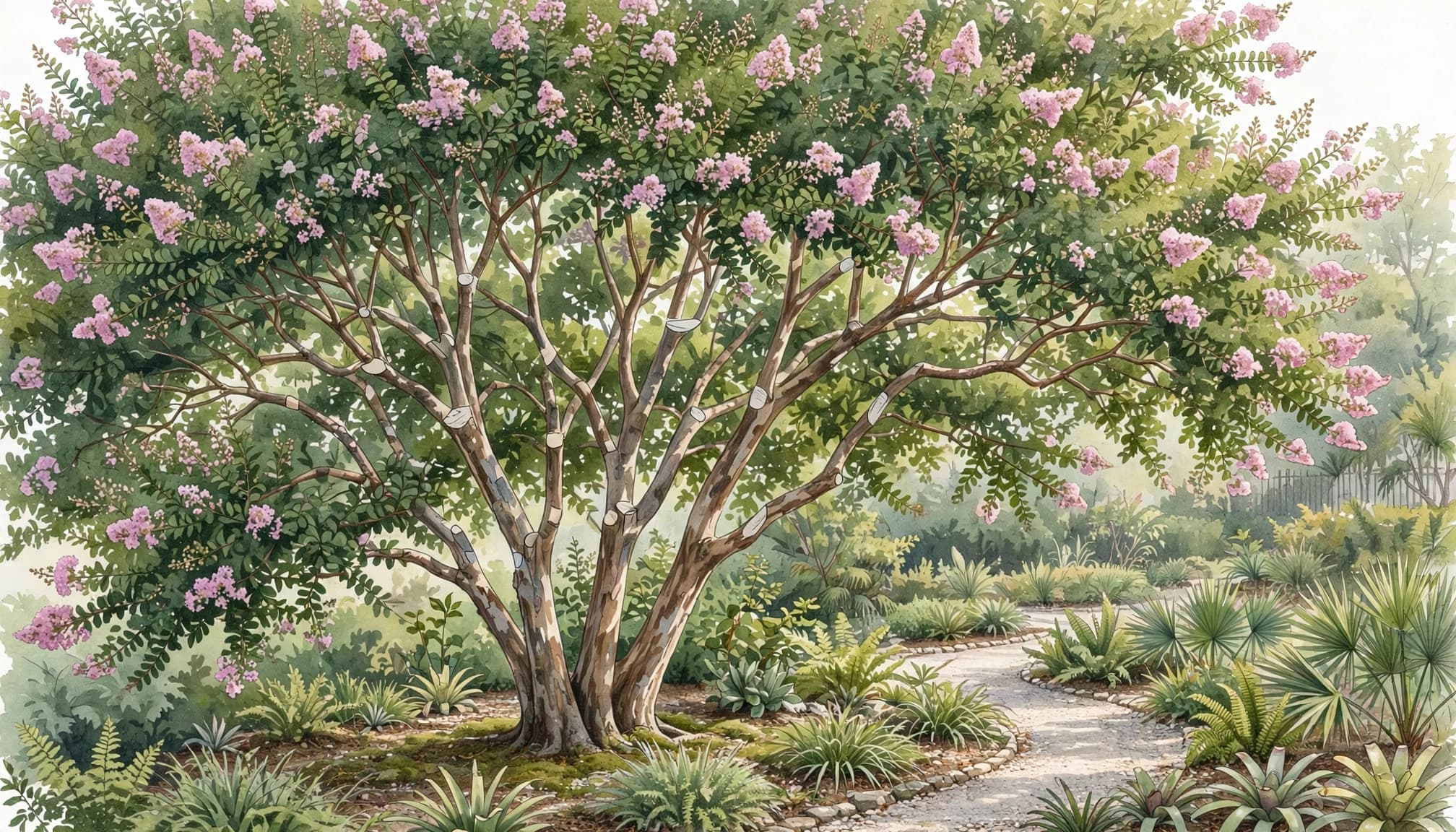
Crape Myrtle Pruning Without Topping
Crape myrtle pruning should preserve the tree's natural canopy instead of cutting its trunks back to stubs. A lighter approach keeps the graceful shape that makes this flowering tree popular in Southwest Florida landscaping.
If your tree has already been topped, it can take time to regain a balanced appearance. Start by understanding how topping changes the canopy and how the tree fits into your yard.
What topping does to a crape myrtle
Topping is the practice of cutting large trunks or major branches back to blunt stubs. On crape myrtles, this practice is sometimes called "crape murder" because it changes the tree's shape so dramatically.
A naturally growing crape myrtle has a branching canopy above its distinctive trunks. Topping replaces much of that structure with a row of exposed ends at roughly the same height.
The shape changes long after the initial cut
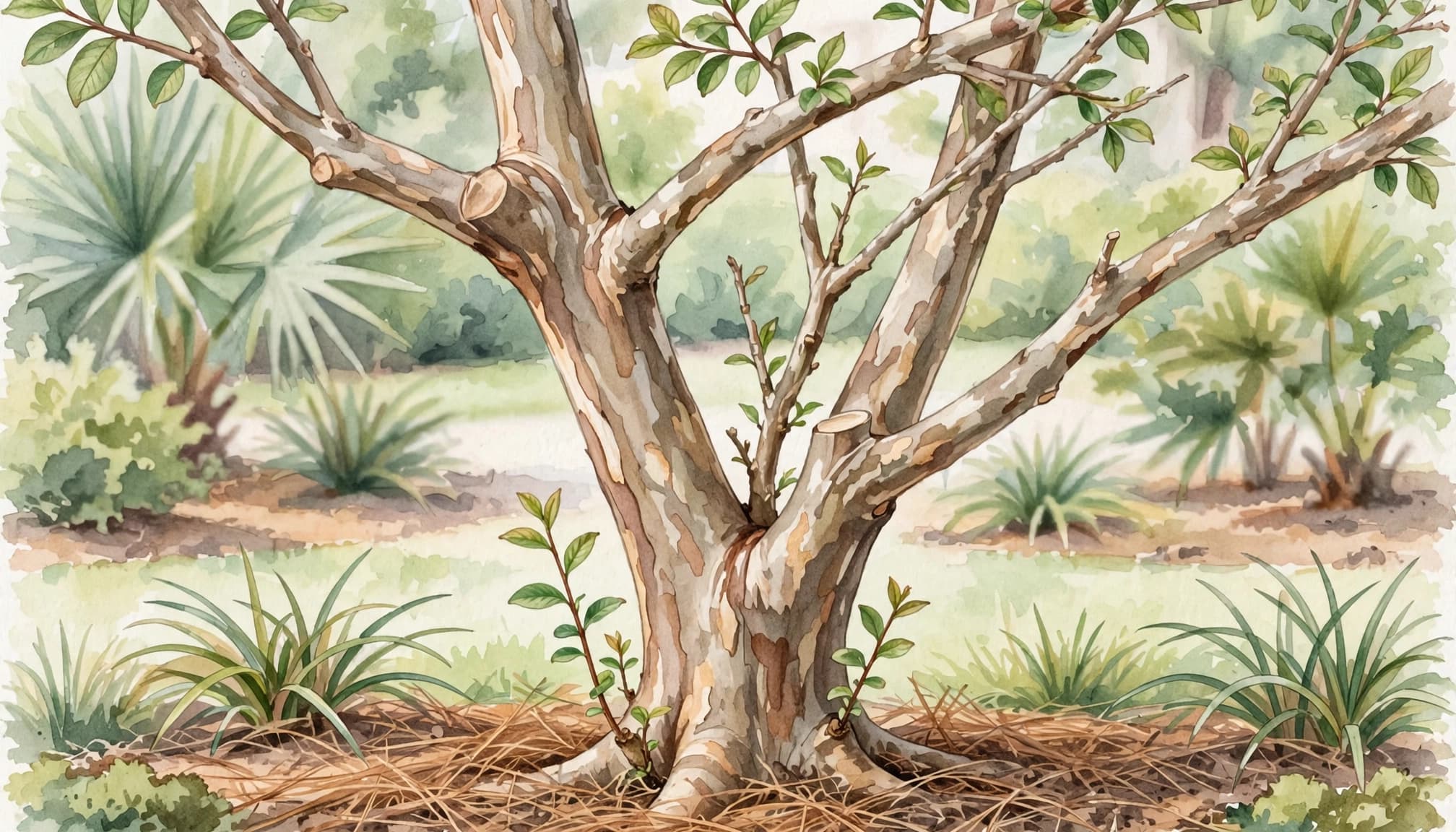
New shoots can grow around the old stubs, creating dense clusters where the tree once had a more open outline. Repeated topping can also leave swollen, knobby areas at the same height.
The canopy may fill in again, but those old cut points remain visible when the tree has fewer leaves. Its original branching pattern is difficult to recover quickly.
Flowering doesn't require topping
Crape myrtles flower on new growth, but that doesn't mean they need their trunks cut back to produce blooms. Healthy trees can flower without the annual practice of topping.
For a tree beside a patio or entry, the natural form is part of its appeal throughout the year. Our guide to patio trees for paved areas compares crape myrtles with other small trees that can complement an outdoor living space.
Look at the whole tree, not just its height
A crape myrtle's character comes from the relationship between its trunks and canopy. Before deciding that a tree needs a major change, look at it from the street, the front door, and any nearby seating areas.
The view beneath the tree matters too. Attractive bark and a branching trunk can become a feature in their own right, especially when the tree has room around it.
Understand its natural growth habit
Crape myrtles come in different sizes and forms. Some grow as single-trunk trees, while others develop several trunks. Cultivar, age, and previous pruning all affect the finished shape.
A multi-trunk tree doesn't need to look perfectly symmetrical to work in a front yard. Slight differences between the trunks can give it a natural appearance, provided the tree has enough room to grow.
Make room for the canopy
A canopy needs space above and around it. A tree squeezed against a roofline or planted beneath a low obstruction can become a recurring maintenance problem, even if it looked proportionate when first installed.
If the tree is consistently too large for its location, topping won't change its underlying growth habit. A long-term solution may involve rethinking the planting space or choosing a smaller cultivar when it's time for a replacement.
Choosing a crape myrtle that fits your yard
The right size makes natural-looking crape myrtle pruning easier. A variety that fits its planting space is less likely to need repeated attempts to control its height.
Our comparison of small trees for Cape Coral front yards lists crape myrtles at roughly 15 to 25 feet tall and 10 to 15 feet wide for the types included there. Cultivars vary , so those figures aren't a size guarantee for every crape myrtle.
Consider the space at maturity
Look beyond the size of the nursery plant. A small tree beside a walkway may look well placed on planting day, but its mature canopy needs room above that walkway.
Consider nearby windows, eaves, lighting, and other plants as part of the same layout. A tree that fits the available space can provide summer color without becoming the center of an ongoing clearance problem.
Give it a sunny position
Crape myrtles are suited to full sun. A sunny position also helps make their summer flowers a visible feature of the yard.
In a narrow front bed, compare the tree's eventual spread with the space available between the home and the street. If a smaller plant would fit better, changing the plant choice is more practical than relying on severe pruning year after year.
Plan around patios, walkways, and driveways
Crape myrtles can work well near a patio, but they should be part of the layout rather than an afterthought. The canopy, planting bed, and paved surfaces all need enough space to function together.
For a new patio, consider where people will walk and sit as well as where the tree will grow. A tree can add color near a seating area without being positioned directly beside a door or outdoor dining table.
A planting area also needs room for soil and access to water. Avoid treating every open strip between paved surfaces as a suitable tree bed. The space may look generous when empty but feel crowded once the tree and neighboring shrubs mature.
If you're planning a larger project, the backyard renovation sequence covers how drainage, hardscape, and planting work fit together. Planning these elements together is useful when a concrete contractor is also installing or repairing a nearby surface.
Expect some seasonal cleanup
A natural canopy still comes with ordinary yard maintenance. Crape myrtles can drop flowers and leaves, and their seed pods and peeling bark can add to the material beneath the tree.
That isn't a reason to top one. It is a reason to consider where the tree sits and how you use the space below it.
Near pavers and outdoor seating
Flowers and leaves are more noticeable on a pale patio than in a mulched planting bed. They can also collect around furniture and along the edges of a walkway.
For a patio that needs a deeper refresh, schedule paver cleaning after the surrounding yard work. That keeps loose plant material and other debris from settling back onto a freshly cleaned surface.
Near lawn and artificial turf
A crape myrtle can provide a vertical feature beside a lawn or artificial turf area. Both surfaces still need attention when flowers, leaves, or bark collect on top.
Leave a suitable planting space around the trunk rather than expecting turf to replace the tree's growing area. A defined bed can make the transition between the tree and the rest of the yard look intentional.
What to expect after a tree has been topped
If your crape myrtle has been topped for years, its appearance won't return to its original form overnight. The old cut points and clusters of regrowth may remain visible for some time.
Start by looking at the tree as it stands now. Note its overall height, the condition of the trunks, and how much room it has around nearby structures. These observations give a tree professional useful context when discussing the tree's future.
Allow time for a better shape
A previously topped tree may need a gradual approach. Its next canopy depends on the growth that remains, the condition of the tree, and the space available.
Resist the urge to repeat the same drastic treatment simply because that's how the tree has been maintained before. Continuing to top it maintains the cycle of blunt stubs and dense regrowth.
Consider whether the location still works
Sometimes the more difficult issue is the site. A large cultivar in a tight bed may keep growing into the same roofline or walkway.
In that situation, talk through the long-term options with a qualified tree professional. Preserving the existing tree may be possible, but a better-sized replacement can be worth considering when the available space is limited.
Know when to call a tree professional
Some crape myrtles are small enough for a homeowner to assess from the ground. Others have large limbs above a roof, screened pool enclosure, driveway, or other area where falling wood could cause injury or damage.
Call an ISA-certified arborist when you see major decay, a trunk crack, a fresh lean, or a large damaged limb over a structure. Trees near utility lines also require qualified professionals who can assess the work safely.
Storm damage deserves particular care. A split or hanging branch can move unpredictably, and a tree with damaged roots or a new lean may be unstable. Keep people away from the area while you arrange professional help.
A useful conversation with an arborist should cover the tree's condition, its location, and your preference for a natural canopy. If your goal is to avoid topping, say so before work begins. That gives everyone a clear understanding of the appearance you're trying to preserve.
Make the tree part of the landscape
A crape myrtle often looks most at home when the rest of the yard gives it room to be the focal point. Smaller shrubs or ground covers can fill nearby beds without competing for the same space.
Keep mulch a few inches away from the trunks. This leaves the base visible and avoids holding moisture against the bark. A defined bed also separates the tree from lawn or paving, which makes the outdoor space easier to maintain.
Think about the view from inside the house as well. A tree placed where you can see its canopy from a window offers a different effect than one tucked into a narrow side yard. In a front yard, the same tree might help frame an entry or soften the edge of a driveway.
For a broader planting plan, our Florida-friendly landscape design ideas cover ways to combine plants and outdoor surfaces for Cape Coral conditions. Our landscape design and installation services can also help bring a planting layout together.
Keep the natural canopy in view
Crape myrtles don't need topping to produce their summer flowers. Their trunks and branching canopy give them year-round appeal, and preserving that form helps the tree look at home in the yard.
The strongest long-term plan starts with a tree that fits its space . If yours has already been topped or presents a safety concern, a qualified tree professional can help you assess its condition and discuss the next step.