


Cape Coral Fertilizer Rules for Residential Landscapes
Fertilizer can help a Cape Coral lawn, but applying it at the wrong time or too close to a canal can send nutrients into local waterways. The Cape Coral fertilizer rules set seasonal restrictions, product limits, and a 15-foot waterway buffer for residential landscapes.
The main dates are easy to remember: nitrogen- or phosphorus-containing fertilizer is prohibited from June 1 through September 30. Outside that period, the rules still govern how much nitrogen you can use, what kind of product qualifies, and where it can be applied.
Key takeaways
- The seasonal fertilizer blackout runs from June 1 through September 30 .
- From October 1 through May 31 , turf and landscape fertilizer must contain at least 50% slow-release nitrogen .
- The annual nitrogen limit is 4 pounds per 1,000 square feet .
- Keep fertilizer at least 15 feet from canals and other listed waters.
- Avoid applying fertilizer before heavy rain or during certain Lee County storm watches and warnings.
These requirements come from Cape Coral's City Ordinance 79-21 , effective February 1, 2022. The rules apply to homeowners as well as commercial applicators.
Cape Coral fertilizer rules at a glance
The ordinance regulates fertilizer containing nitrogen or phosphorus on turf and landscape plants. It restricts when you can apply those nutrients and sets limits for applications outside the seasonal blackout.
| Requirement | Cape Coral rule |
|---|---|
| Seasonal blackout | June 1 through September 30 |
| Waterway setback | At least 15 feet |
| Slow-release nitrogen | At least 50% from October 1 through May 31 |
| Annual nitrogen maximum | 4 pounds per 1,000 square feet |
| Phosphorus fertilizer | Allowed only with qualifying soil-test evidence of deficiency |
The annual nitrogen limit is a ceiling, not a target. Use only the amount your lawn or plants need, and follow the product label along with the city's restrictions.
When fertilizer is prohibited
Seasonal and storm-related restrictions
From June 1 through September 30, you may not apply fertilizer containing nitrogen or phosphorus to turf or landscape plants. The restriction covers the rainy-season months, when runoff can carry nutrients from lawns into storm drains, canals, and other waters.
Fertilizer is also prohibited when a Lee County flood, tropical-storm, or hurricane watch or warning is in effect. Heavy rain likely is another reason to postpone an application. Even when the calendar allows fertilizer, wet soil and fast-moving runoff can carry nutrients away before plants can use them.
Possible May extension
The City Manager may extend the seasonal restriction into May, from May 1 through May 31. That authority is part of the ordinance. The standard seasonal blackout remains June 1 through September 30, while any extension is a separate action.
A practical schedule should account for the weather as well as the calendar. Southwest Florida's yard maintenance calendar offers seasonal context for lawn and landscape care.
Fertilizer rules from October through May
Slow-release nitrogen and the annual limit
From October 1 through May 31, fertilizer used on turf or landscape plants must contain at least 50% slow-release nitrogen . Check the product analysis before buying, then use the lowest rate needed for the area you are treating.
Cape Coral caps nitrogen at 4 pounds per 1,000 square feet per year . That total applies across applications, so keep track of what you have used. A heavy application does not compensate for sandy soil or weak growth, and excess nutrients can move beyond plant roots.
Phosphorus requires a soil test
Phosphorus fertilizer is prohibited unless a soil test from the previous two years shows that the soil is deficient in phosphorus. The test must use a method and limits recommended by the University of Florida/Institute of Food and Agricultural Sciences (UF/IFAS).
A yellow patch or struggling shrub does not, by itself, establish a phosphorus deficiency. Cape Coral's sandy soils can have other issues, including drainage, salt, and low nutrient retention. Learn about common Cape Coral soil problems before treating a whole lawn or bed.
Keep fertilizer 15 feet from waterways
Cape Coral requires a 15-foot setback from ponds, streams, watercourses, lakes, canals, wetlands, and the top of a seawall. Don't apply fertilizer within that buffer. Hand dispersion is permitted only when you can keep fertilizer from reaching the water.
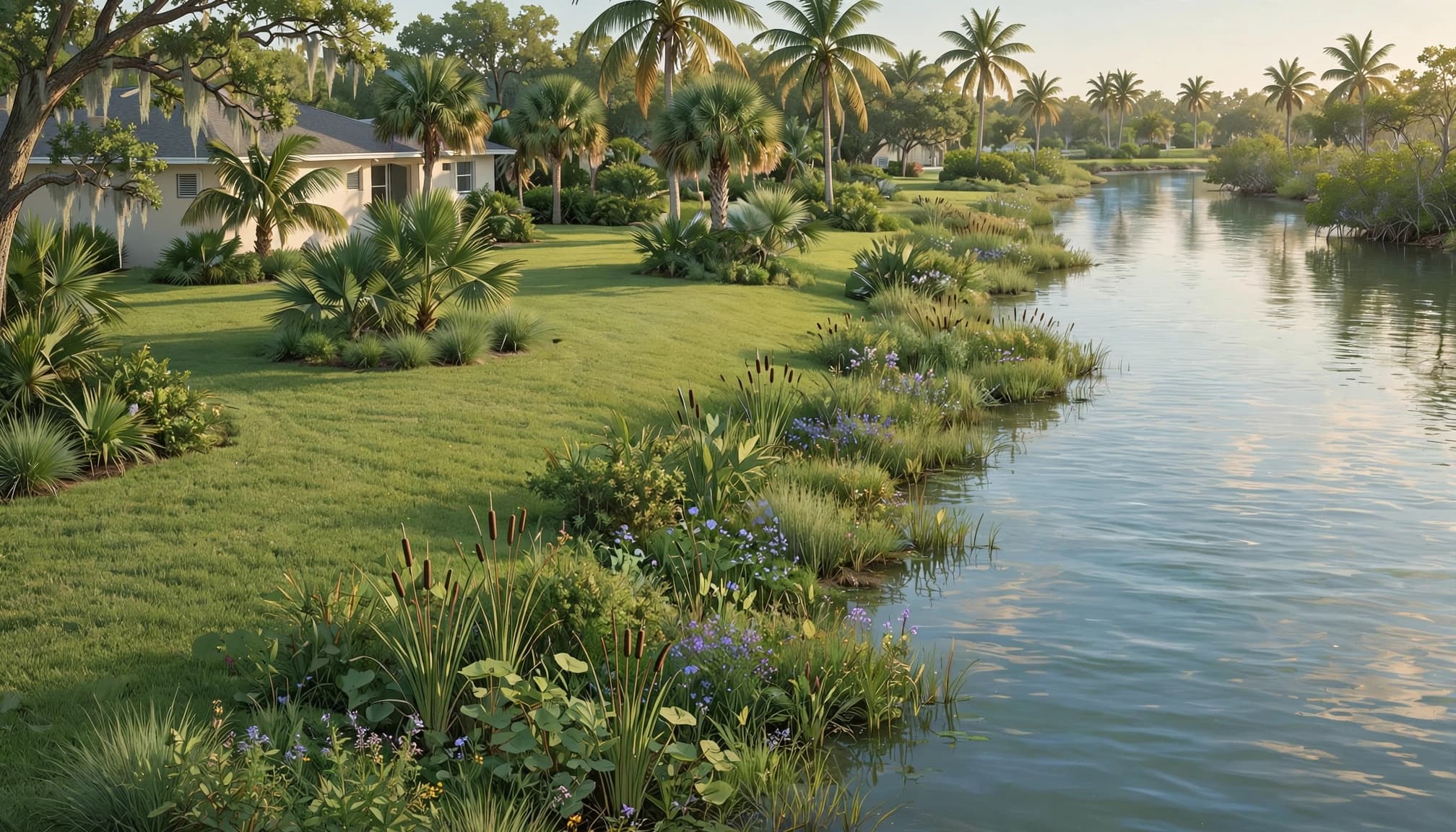
Keep granules away from the water's edge, storm drains, and drainage channels. A deflector shield on a spreader can help prevent fertilizer from scattering onto restricted areas and hard surfaces. If granules land on a driveway, sidewalk, or pavers, collect them promptly rather than washing them toward a drain.
Planting choices can also help reduce ongoing maintenance near canals. Florida-Friendly landscape design for Cape Coral homes includes ideas suited to local conditions.
New sod, seeding, and landscape plants
Newly seeded or sodded areas
The ordinance generally prohibits fertilizer containing nitrogen or phosphorus before seeding or sodding and for the first 30 days afterward . An emergency hydroseeding exception applies for erosion control.
Avoid treating new turf as an automatic reason to fertilize. Establishment depends on the grass, soil preparation, irrigation, and the product label. The seasonal blackout and weather restrictions still matter.
New landscape plants and listed exemptions
Cape Coral's summary describes an exception for new landscape plants: fertilizer may be used for 60 days beginning 30 days after planting . This narrow allowance does not remove other restrictions, such as the seasonal blackout, waterway buffer, or storm-related prohibition.
Other listed exemptions include vegetable gardens outside the 15-foot waterway buffer, primarily organic yard-waste compost and mulch used as soil conditioners, and bona fide farming, pasture, or scientific-research lands. These exceptions do not make ordinary lawn fertilizer exempt from the ordinance.
Apply fertilizer carefully
Measure and control the spread
Measure the area before filling a spreader, then calculate the product amount from its label. A calibrated spreader helps keep the application even and avoids putting too much fertilizer on a small lawn.
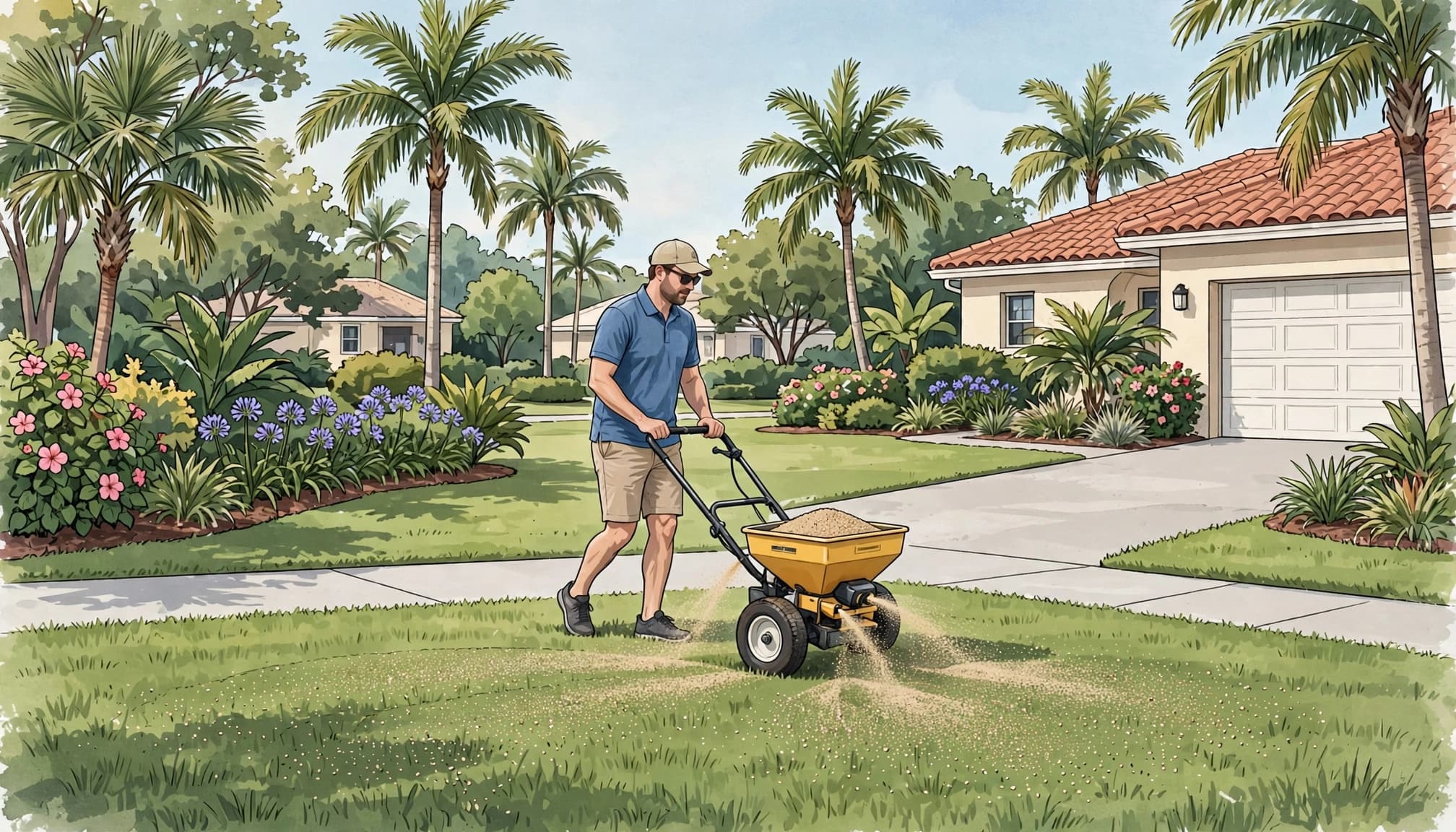
Apply only when the ordinance allows it and conditions are suitable. Keep granules off sidewalks, pavers, driveways, and streets. If fertilizer reaches an impervious surface, immediately contain and remove it. Don't hose or blow it into a storm drain.
Protect drains during yard work
Fertilizer is only one source of nutrient runoff. Grass clippings and other yard debris must not be swept or blown into drains, ditches, drainage channels, water bodies, sidewalks, or roadways.
Hardscape work can change how water moves through a yard. If a concrete company is replacing a slab or installing a driveway, coordinate the work with irrigation and grading so runoff does not carry yard debris or fertilizer toward a drain. The same care applies during paver cleaning: contain dirty rinse water rather than sending it toward canals or storm drains.
Cape Coral, Lee County, and Florida rules
City limits and unincorporated county areas
Cape Coral's ordinance applies within the city. Unincorporated Lee County guidance has its own requirements, including a 10-foot waterway buffer. That county distance is not the Cape Coral standard: homeowners within Cape Coral must follow the city's 15-foot setback.
Both jurisdictions list a June 1 through September 30 seasonal restriction, but their other requirements should not be treated as interchangeable. Boundaries matter, especially for properties near the edge of the city.
State law and applicator training
Florida Statute 403.9337 provides a statewide framework for local fertilizer regulation and allows more stringent local standards when statutory criteria are met. Cape Coral's local dates, buffer, and annual nitrogen cap come from its ordinance.
Commercial and institutional fertilizer applicators must complete UF Extension's six-hour training program, "Florida-Friendly Best Management Practices for Protection of Water Resources by the Green Industries." Homeowners should also keep the local restrictions in mind when hiring landscape maintenance.
FAQ
Can I apply fertilizer in October?
Yes, if no other restriction applies. From October 1 through May 31, fertilizer for turf or landscape plants must contain at least 50% slow-release nitrogen, and the annual nitrogen limit remains 4 pounds per 1,000 square feet.
Can I fertilize before a storm?
No. Fertilizer is prohibited when heavy rain is likely, as well as during a Lee County flood, tropical-storm, or hurricane watch or warning. Wait until those conditions have passed and the seasonal rules allow application.
Does the 15-foot setback apply to a canal?
Yes. Canals are specifically included in Cape Coral's list of waters requiring the 15-foot buffer. The rule also covers ponds, streams, lakes, wetlands, and other listed watercourses.
A safer fertilizer plan for your yard
Cape Coral's rules set clear limits: follow the June-through-September blackout, use qualifying slow-release nitrogen during the rest of the year, and keep fertilizer at least 15 feet from waterways. Apply only what the lawn needs, and keep granules and yard debris out of drains.
Careful timing and cleanup protect both your landscape and the canals that run through Cape Coral.