


Paver Edge Restraints In Cape Coral What Fails Without Them
If your paver driveway or pool deck is starting to "walk" sideways, it usually isn't the pavers' fault. Most of the time, the weak link is missing or failing paver edge restraints .
In Cape Coral, that weak link shows up fast. Heavy rain loosens sand, sandy soil shifts, and vehicle tires twist pavers at the edges. Without a solid border holding everything tight, the whole surface slowly spreads like a book sliding off a shelf.
This guide explains what fails, what you'll see first, and what a correct edge build should include for Southwest Florida homes.
Why Cape Coral conditions punish unrestrained pavers
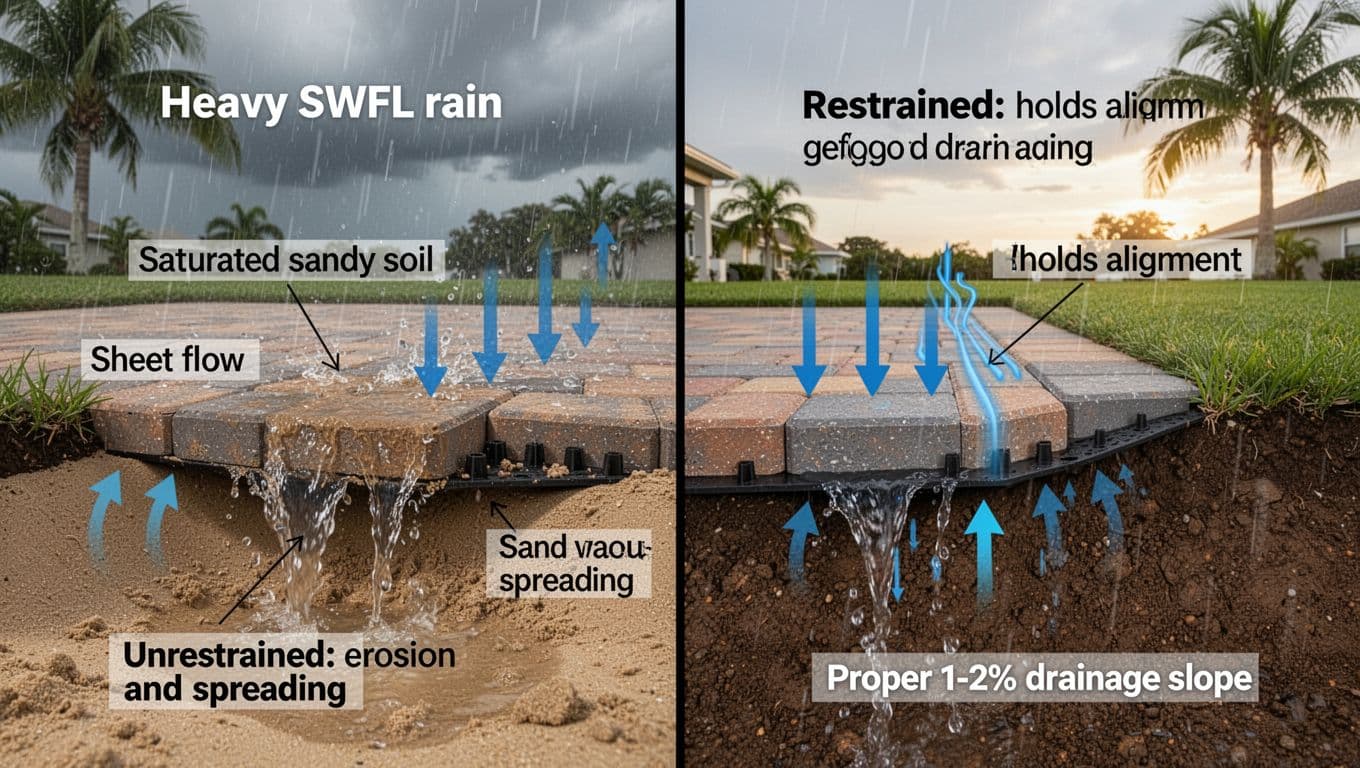 Side-by-side diagram of how heavy rain and sandy soil affect unrestrained vs. restrained paver edges, created with AI.
Cape Coral's soil and weather can be hard on pavers, even when the surface looks "fine" at first. Sandy soils drain quickly, but they also move easily when saturated. Add a few hard storms and that sand can migrate out from under the edge.
Local weather matters, too. Cape Coral saw severe thunderstorms on February 15, 2026, with heavy rain, hail, and lightning in the area. Events like that can push water across a driveway or patio in minutes. When sheet flow hits an open edge, it can carry bedding sand and joint sand with it.
Driveways take another hit from turning forces. Each time a tire pivots while backing out, it shoves laterally on the outer pavers. Over time, those small pushes add up. Patios and pool decks are different, but they still suffer because splash-out, hose water, and poor drainage keep the base damp.
Drainage and grading connect the whole system. A proper 1 to 2 percent slope helps water move off the surface instead of soaking into the edges. That's why edging is not just "trim," it's part of the structure. If your home's landscaping beds, rock borders, or artifical turf butt up against pavers, edging becomes even more important because those materials can hide edge movement until it's advanced.
What fails first when paver edge restraints are missing
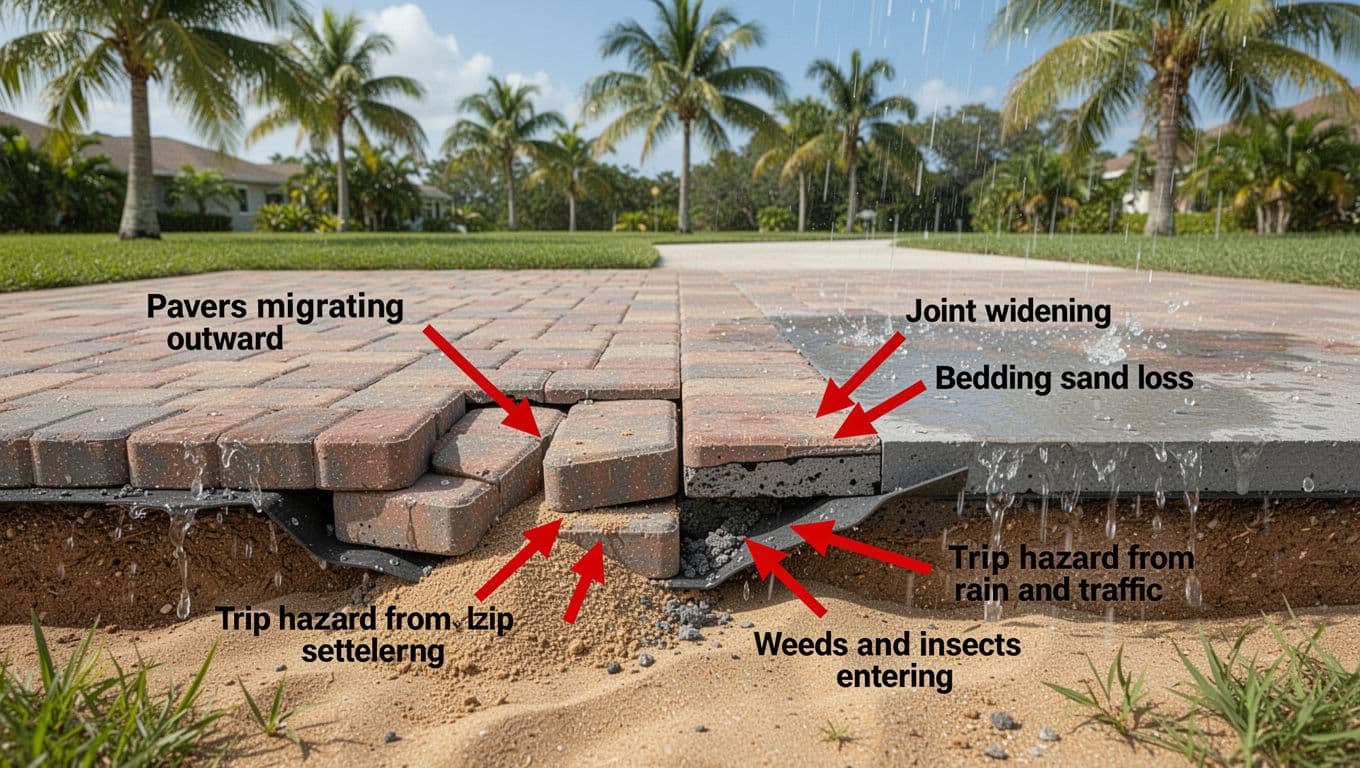 Common failure signs at the edge of a paver surface, created with AI.
When edge restraints are weak or absent, the failure usually starts quietly at the perimeter, then spreads inward. Think of it like a zipper opening one tooth at a time. The field pavers are interlocked, but the outside row has nothing to "push back" against.
Here are the early warning signs Cape Coral homeowners often notice:
- Widening joints at the border , then joint sand disappears after rain.
- A small lip or trip edge where the outside pavers settle or tilt.
- Pavers "fanning" outward near driveway corners where cars turn.
- Weeds and ants showing up in joints that used to stay tight.
One overlooked trigger is paver cleaning . Pressure washing is great for stains, but it can also blast joint sand out. If the edge is already loose, that missing joint sand speeds up shifting. After cleaning, re-sanding and compacting matters more than most people think.
If you can wiggle an edge paver by hand, the border is already losing the fight.
For tolerance and fit expectations, it helps to review the industry guidance on alignment, joints, and finished surfaces in ICPI construction tolerances and recommendations. While every site differs, the big idea is simple: pavers perform as a system, and open edges must be contained.
What a correct edge restraint build looks like (contractor-level detail)
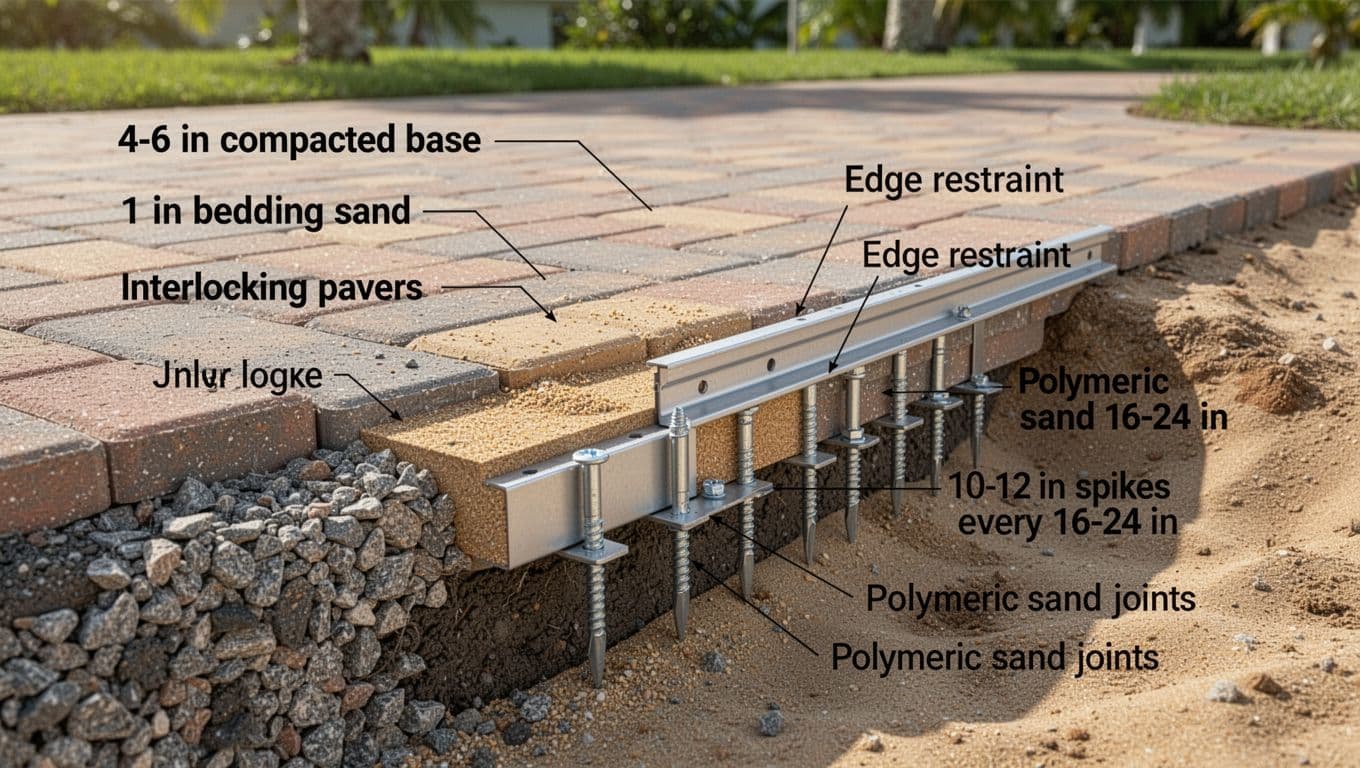 Cross-section of a proper paver edge restraint assembly, created with AI.
A good edge restraint is only as strong as what it's anchored into. In Southwest Florida, that usually means a compacted aggregate base, not just loose sand. Many residential installs use a base in the 4 to 6 inch range for light vehicular areas, but depth and materials vary by soil, load, and drainage plan. Pool decks and patios may differ as well.
Here's what installers focus on when they want edges to last:
First, the base should extend past the outside paver line. A common rule of thumb is about 6 inches beyond the edge, so spikes land in solid, compacted material, not soft backfill. Next, bedding sand stays around 1 inch, screeded flat, and the restraint sits snug to the pavers.
For spike-down restraints, many jobs use 10 to 12 inch spikes , driven into the base. Spacing often lands around 16 to 24 inches on patios, and tighter on curves or driveways (sometimes 8 to 12 inches). In other words, the more turning force and water exposure, the more the edge needs reinforcement.
Drainage ties it together. A 1 to 2 percent slope helps, and the outside of the restraint should be backfilled and compacted so the edge cannot flex.
For deeper technical references, CMHA (which includes ICPI resources) outlines edge restraint expectations in Edge Restraints for Interlocking Concrete Pavements and details system components in the Guide Specification for Interlocking Concrete Pavement.
If your pavers meet a slab, garage apron, or sidewalk, don't assume the concrete automatically "counts" as restraint. Sometimes it does, but only when it fully supports the edge and the base is locked in. A qualified concrete company can also help when the real issue is a failing concrete border or poor transitions (see concrete installation guidance for Cape Coral).
Troubleshooting, repair choices, and whether DIY makes sense
Use this table to connect what you see with what usually causes it.
| Symptom you notice | Likely cause | Fix that lasts |
|---|---|---|
| Border joints keep opening up | No restraint, or spikes pulled loose | Add/replace restraint, re-compact base edge, re-sand joints |
| Trip lip at the edge | Edge settlement from sand loss | Pull and reset edge row, rebuild base, install restraint |
| Driveway corners "fan" outward | Vehicle turning force pushing uncontained edge | Stronger restraint, tighter spike spacing, extend base |
| Pavers look clean but feel loose after washing | Joint sand removed during paver cleaning | Refill joints (often polymeric), compact, confirm edge is tight |
| Water pools near the edge | Flat grade or clogged drainage path | Regrade to 1 to 2 percent slope, address runoff, then reset pavers |
DIY can be reasonable if the problem is small and accessible. A short patio edge that's spreading, with no major settling, may only need edge excavation, added base, a new restraint, then re-sanding and compacting. On the other hand, driveways, pool decks, and large settled areas usually need pro tools and a better eye for drainage.
Cost-wise, restraint work pays back because it prevents repeat repairs. Small fixes can stay in the few-hundred-dollar range, while larger resets climb quickly. For local pricing context, see paver repair costs in Cape Coral. If you're seeing widespread movement, it's often smarter to schedule an evaluation for professional paver repair services before the edges pull the whole field out of alignment.
Good repairs also blend with the yard. Proper grading, bed edges, and drainage are part of the same landscaping picture, not separate projects.
Conclusion
Pavers don't fail all at once, they fail at the edges first. In Cape Coral, missing paver edge restraints often leads to spreading, sand loss, trip hazards, and repeat maintenance after heavy rains. A well-built edge, anchored into a compacted base and supported by good drainage, keeps the whole surface locked tight. Take a slow walk around your driveway or pool deck after the next storm, the border will tell you what's happening.