


How to Identify Doveweed in St. Augustine Lawns
Doveweed can blend into St. Augustine grass, but its narrow, glossy leaves, low stems, and small blue-purple flowers offer useful clues. To identify doveweed reliably, look at the whole plant rather than relying on the color of a patch.
A lawn can contain several kinds of plants growing together, so get close enough to separate the suspicious growth from the surrounding grass. The following visual checks will help you recognize what you're seeing.
What Doveweed Looks Like in St. Augustine Grass
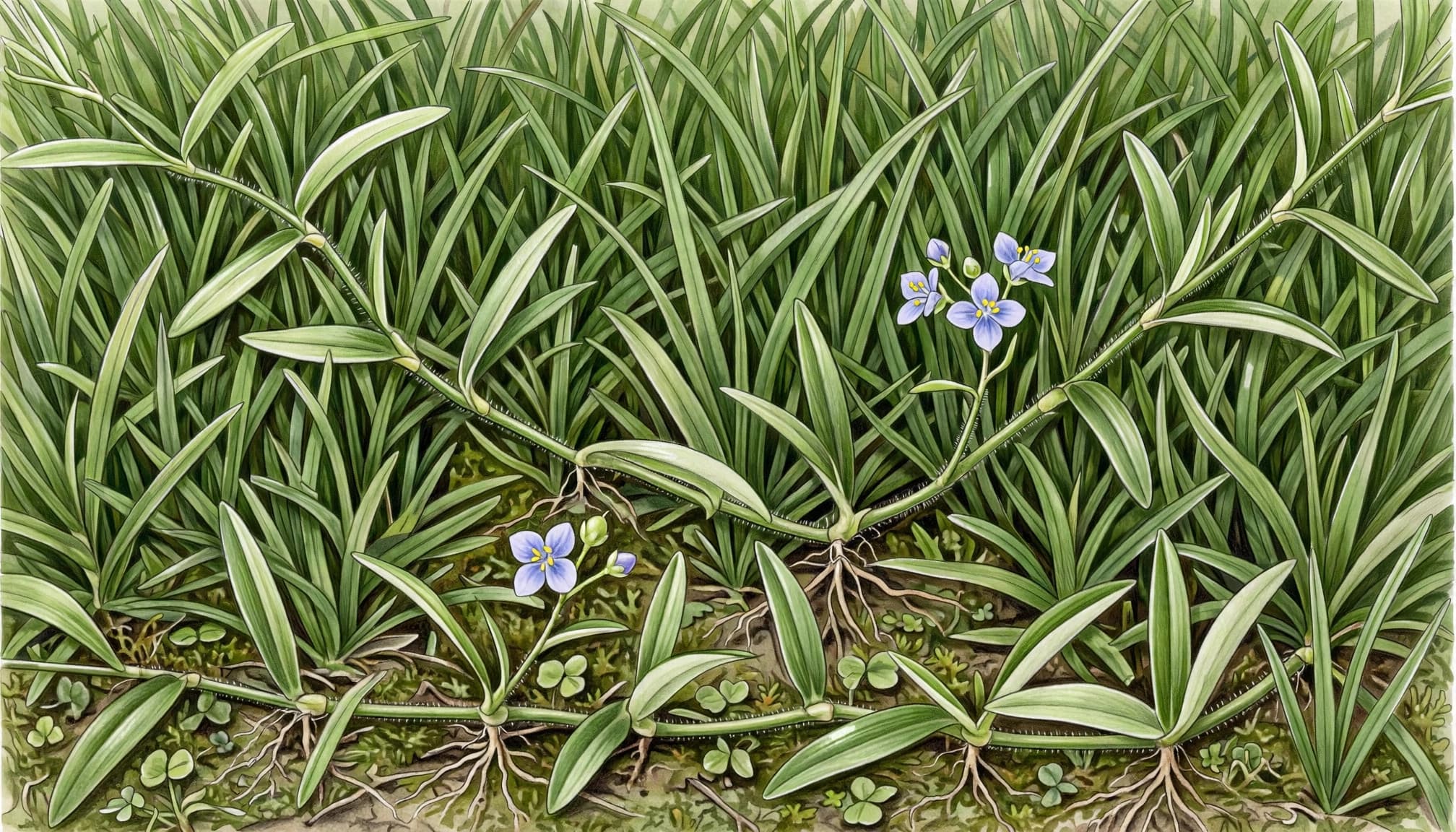
Doveweed, or Murdannia nudiflora , has a grasslike appearance that makes it easy to overlook at mowing height. Its leaves grow along low stems, and the plant can form a dense patch among turf blades.
Leaves
Look for narrow, smooth leaves with a glossy surface. They can look somewhat fleshy and have veins that run lengthwise. Leaf size varies, so use the shape and texture along with other clues instead of judging a plant by width alone.
A useful first step is to separate one suspicious leaf from the surrounding lawn. Follow it down toward its base, where you can see how it connects to the stem.
Stems
Doveweed grows close to the ground on creeping stems. Roots can form where those stems touch the soil at joints, also called nodes. Parting the grass often reveals more of the plant than you can see while standing over it.
Because St. Augustine grass also has above-ground runners, a creeping stem by itself doesn't settle the identification. Look for the leaf, stem, and flower characteristics together.
Flowers
Small blue-purple flowers are a helpful clue when they're present. Doveweed flowers have three petals and can sit low among the leaves, so they're easy to miss.
You won't find an open flower on every plant you inspect. A lack of flowers doesn't settle the question, so continue examining the leaves and stems.
How Doveweed Can Blend Into the Lawn
A patch of doveweed may look like a change in the lawn's texture rather than an obvious weed. Its leaves can sit among St. Augustine blades, especially where the two plants overlap.
Look at the Patch From Two Angles
Start by standing back and looking across the lawn. Note areas that look flatter, denser, or different in texture from the grass around them. Then kneel beside a suspicious area and part the blades.
The view from above helps you find a patch. The close view helps you see whether it contains a separate plant. A patch that looks different isn't proof of doveweed until you examine its structure.
Follow Individual Leaves to Their Bases
Leaves from neighboring plants can cross over one another. If you pick up a loose blade, you may not know which stem it came from.
Instead, follow a leaf down to the point where it joins the plant. Compare several leaves within the patch, then trace the stem along the soil. That gives you more information than a single close-up of the lawn's surface.
How to Inspect a Lawn for Doveweed
A careful inspection takes only a few simple tools: a hand trowel, a small bag or container, and a phone or camera. Choose an area where you can see both the suspicious growth and nearby St. Augustine grass.
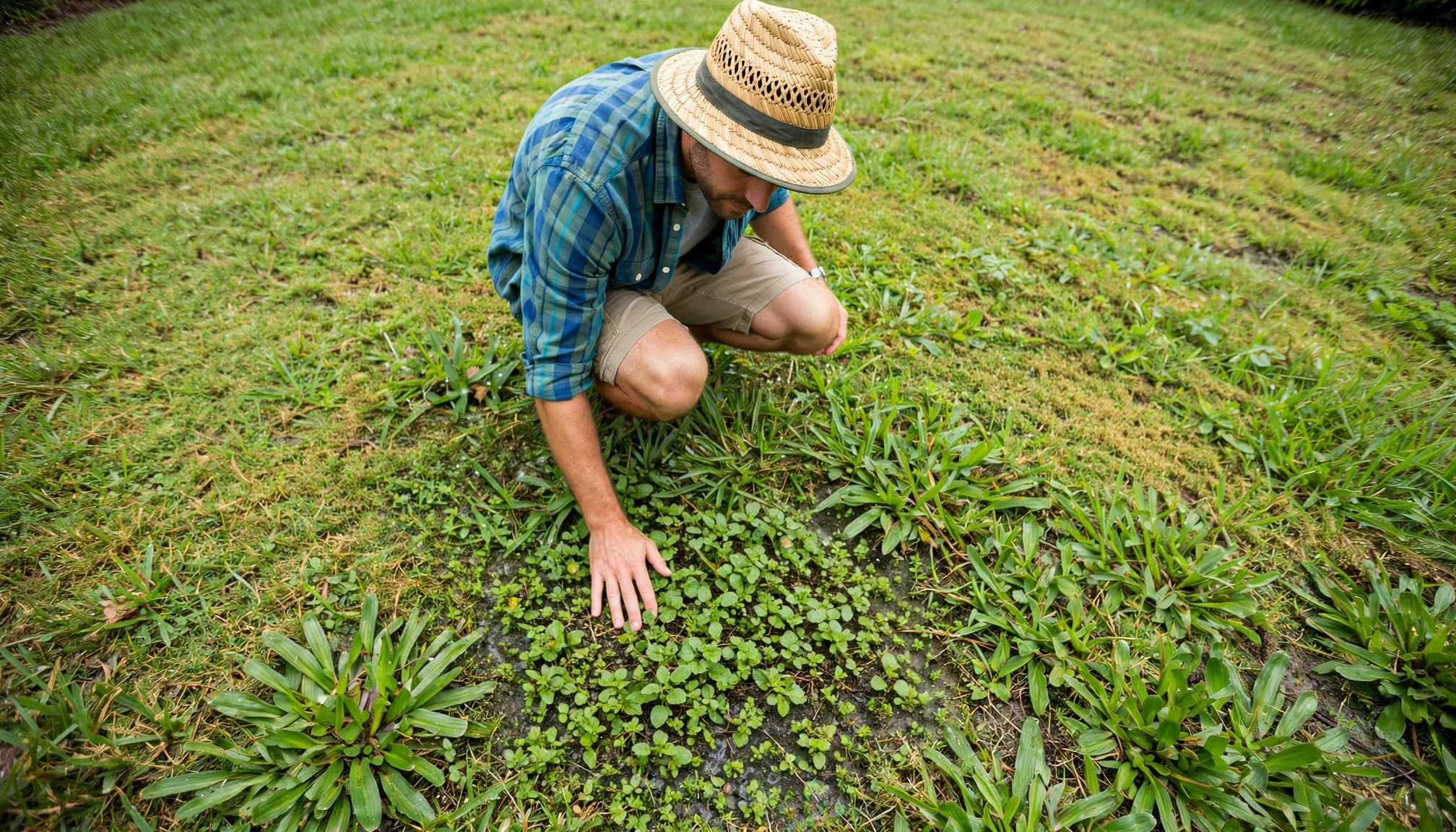
- Locate the patch. Walk across the lawn and mark areas where the leaves or growth pattern look different from the surrounding turf.
- Part the grass. Use your hands to expose the plant bases without pulling the first leaf you see. Look for stems lying close to the soil.
- Trace a suspect stem. Follow it through the patch and look at the joints, attached leaves, and any roots at the nodes.
- Look for flowers. Move the leaves aside gently and search near the base of the growth for small blue-purple blooms.
- Lift a small sample. If the plant remains difficult to see, use a trowel to lift a small piece with its stems and roots attached. Place it in a bag or container.
Take a sample from the edge of the patch if possible. That area gives you a chance to see the suspect plant beside the turf without disturbing the center of the lawn.
Separate Doveweed From St. Augustine Grass
St. Augustine grass and doveweed can both grow low and have leaves that appear grasslike. The practical difference is easier to see when you compare plants at their bases rather than viewing a mixed patch from above.
Compare the Leaf Texture
Examine leaves that are still attached to each plant. Doveweed's narrow, glossy leaves can look different from the broader blades commonly associated with St. Augustine grass. Leaf width alone isn't a dependable test, though, because size varies with the plant and the lawn.
Look for several matching features on the same plant. A glossy leaf attached to a low stem gives you more to work with than a loose blade found on the ground.
Examine the Runners
St. Augustine grass spreads along above-ground runners called stolons. Doveweed also has low stems, so seeing a runner doesn't automatically mean you've found either plant.
Follow the runner to its attached leaves. If you find a small blue-purple, three-petaled flower on the same plant, that provides another useful identification clue. Keep the sample intact so the leaves and stem stay connected.
Where to Look During an Inspection
You don't need to inspect every square foot of turf at once. Start with patches that have caught your attention, then compare them with a nearby area where the St. Augustine grass looks consistent.
Walk along lawn edges as well as through the center. Borders beside a driveway, patio, or planting bed can make it easier to spot a change in texture because you have a clear edge as a reference. Look into the lawn beyond that edge too, rather than assuming the visible boundary shows the full extent of a patch.
If you maintain several separate lawn areas, inspect each one on its own. A front lawn, side yard, and backyard can have different grass density and maintenance histories. Record the location of any suspect growth so you can return to the same spot.
It's also helpful to look before the next mowing. Longer leaves and any flowers may be easier to see before the mower passes over them. If you've already mowed, you can still inspect the stems and leaf bases.
Take Photos That Help With Identification
A single photo of a green patch rarely shows enough detail. Take a few views that show both the plant's setting and its structure.
Capture the Whole Patch
Stand far enough back to include the suspicious area and some surrounding St. Augustine grass. Include a fixed feature, such as a walkway edge, to help you locate the same spot later.
A second photo taken closer to the ground can show how the leaves sit within the turf. Keep the camera steady and make sure the plant, rather than the background, is in focus.
Photograph the Plant Up Close
Part the grass and photograph the attached leaves, the low stem, and any visible joints. If you find a flower, take a separate close-up that shows its color and petals.
Place a coin or ruler beside a sample to show its size. Avoid covering the leaf base with the object, since that connection helps someone understand which parts belong to the same plant.
Keep a Useful Record of What You Find
Write down where you found the plant and whether you saw leaves, stems, roots at the joints, or flowers. A short note on your phone works well. Include the date and label the photos with the location, such as "front lawn near driveway."
If you return to the spot, photograph it from the same position. Consistent photos make it easier to compare the plant's appearance over time. They also help you avoid relying on memory when you discuss the lawn with someone else.
Keep your sample separate from loose clippings. A collection of detached leaves can be difficult to interpret because it doesn't show how each leaf connects to its stem. A small section with those parts intact is more useful.
The strongest clue is a combination of features on the same plant: attached leaves, a low stem, and a flower when one is present.
When to Get Help Identifying a Lawn Plant
If the plant has no visible flowers or the stems are tangled with turf, a local plant-identification resource can help. Your county's UF/IFAS Extension office is a useful place to ask about a sample or clear photographs.
Share the location within the yard and explain what you observed. Include the wide photo, close-ups, and a view of the plant's base. If you're bringing a sample, keep its leaves and stems connected rather than submitting loose clippings.
A lawn can have more than one issue at the same time. For example, the brown material beneath grass blades may be thatch rather than a separate plant. Our guide to St. Augustine thatch removal explains how to examine that layer without confusing it with the green growth above.
For a broader landscaping assessment, we work with homeowners in Fort Myers, Cape Coral, Estero, Bonita Springs, and surrounding Southwest Florida communities. A clear description of the patch helps start that conversation.
Look Closely Before You Decide
Doveweed identification starts at ground level. Its glossy leaves, low stems, and small blue-purple flowers are easier to assess when you separate them from the surrounding St. Augustine grass.
Take a few clear photos and keep the plant parts connected if you collect a sample. Those details give you a better basis for identifying the growth than the color of the lawn alone.