


Paver Pattern Guide For Cape Coral Driveways And Patios
Picking paver patterns sounds like a style choice, until your driveway starts to ripple under turning tires, or your patio develops a wavy spot after a few rainy seasons. In Cape Coral, pattern isn't just looks, it's structure.
This guide breaks down what actually matters for local homes: which patterns handle vehicle traffic best, when borders and edge restraints aren't optional, and how your layout can make future repairs easier (or harder).
If you want a surface that stays tight like well-fit puzzle pieces, start with the pattern, then build the base to match.
Start with how the space will be used (driveway vs patio)
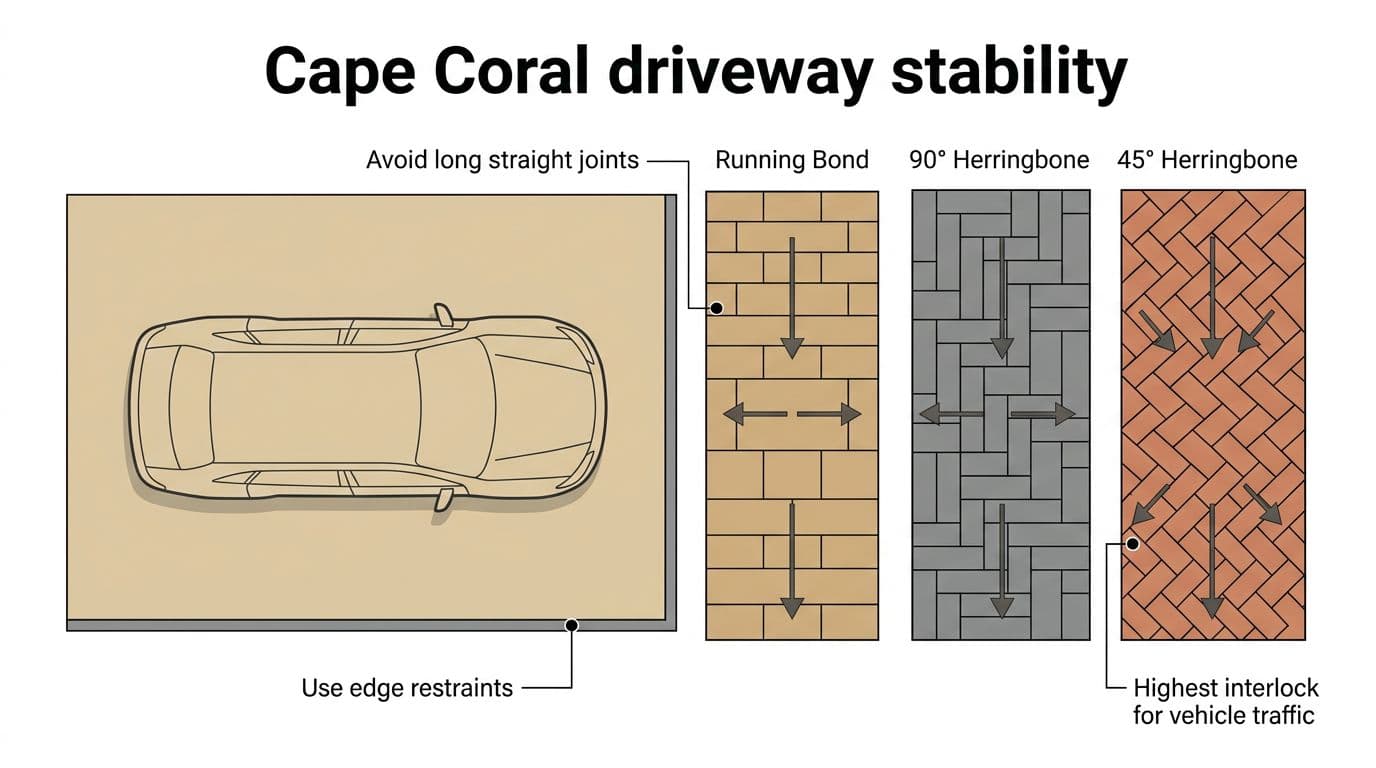 Driveway patterns compared for interlock strength and load spread, created with AI.
A patio and a driveway live very different lives. Patio loads are mostly straight down: people, grills, furniture. Driveways take rolling weight, hard braking, and the worst one, tight turning near the garage and curb.
That's why interlock matters. Interlock is how well pavers "grab" each other so they don't creep. Patterns with long, straight joints can act like zipper tracks. Under traffic, those lines can slowly open up, and you'll see shifting, rutting, and edge spread.
For most Cape Coral driveways, two patterns rise to the top:
- 45° herringbone : The go-to for heavy vehicle traffic and frequent turning.
- 90° herringbone : Also strong, and often a little simpler to lay out in rectangles.
Running bond (brick pattern) can look great, but it's better on patios and walkways unless the base, restraints, and thickness are upgraded.
If your driveway sees daily parking and tight turns, choose herringbone first , then pick color and border style second.
When you're ready to price layouts and options, it helps to talk with a crew that installs for local conditions, not a one-size-fits-all approach. See paver installation Cape Coral for examples of driveway and patio work.
Common paver patterns and what they're best at
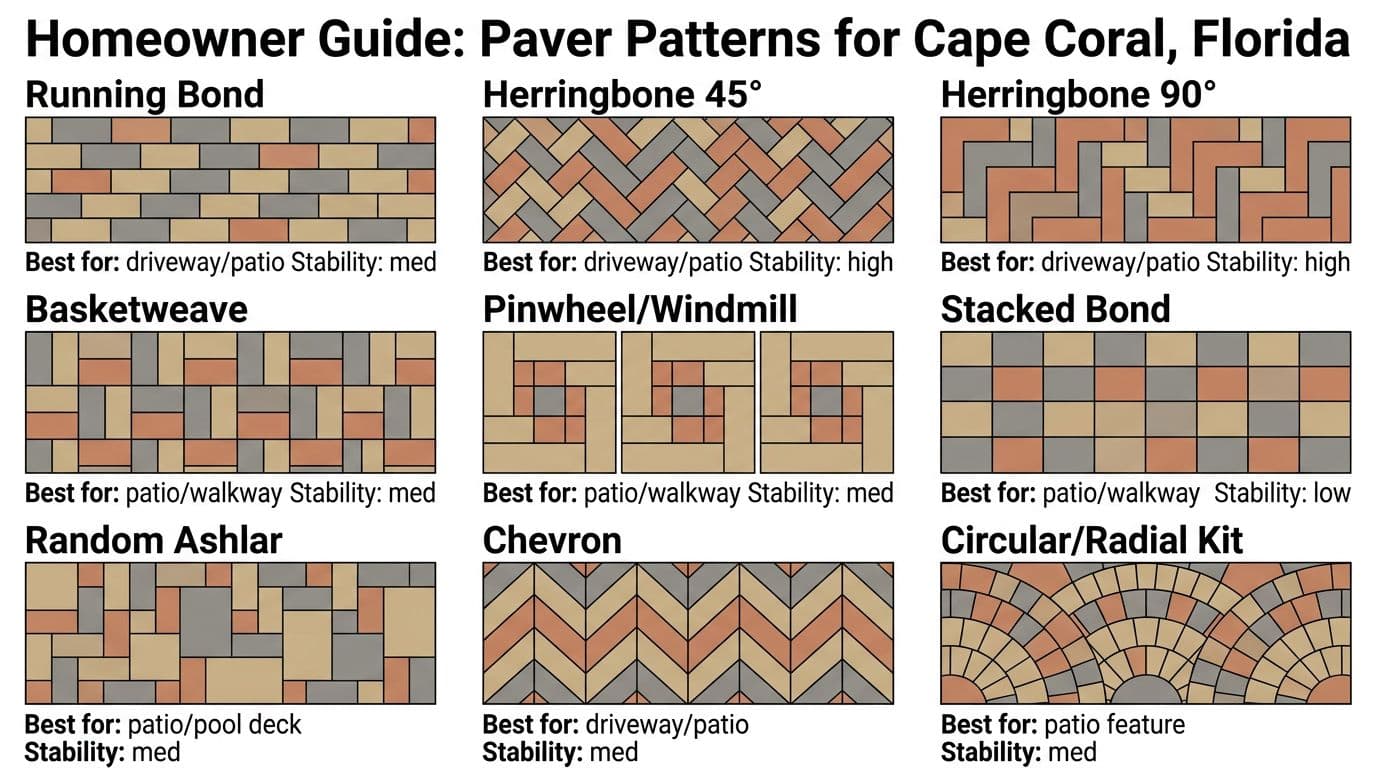 Quick visual guide to popular layouts and stability, created with AI.
Here's a simple way to think about pattern choice: some layouts "lock" like braided rope, while others stack like books. Braided patterns resist movement. Stacked patterns look clean, but they rely more on perfect base work and strong edge restraint.
Use this table as a quick shortlist when you're deciding between driveway and patio layouts.
| Pattern | Best for | Pros | Cons | Relative install difficulty | Typical use in Cape Coral |
|---|---|---|---|---|---|
| 45° Herringbone | Driveways | Highest interlock, resists turning forces | More cuts at edges | Medium-High | Driveways, driveway aprons |
| 90° Herringbone | Driveways | Strong interlock, cleaner borders than 45° | Still needs good restraints | Medium | Driveways, parking pads |
| Running Bond | Patios | Classic look, fewer cuts | Long joints can shift under traffic | Low | Patios, walkways |
| Random Ashlar | Patios | Hides stains, relaxed look | Layout planning takes time | Medium | Patios, lanais, pool areas |
| Basketweave | Patios | Traditional style, good small-area fit | Not as strong as herringbone for cars | Medium | Courtyards, small patios |
| Stacked Bond | Patios | Modern lines, easy to "read" visually | Lowest interlock, shows settlement | Low | Covered patios, low-traffic areas |
| Chevron | Patios | Bold design, strong visual movement | More waste and cuts | High | Accent patios, entry pads |
| Circular/Radial Kit | Patios | Great focal point | Harder repairs if settlement occurs | High | Fire pit areas, round patios |
One more practical tip: match pattern to repair reality . Pavers are modular, which is a huge benefit. Still, patterns with lots of angled cuts can be slower to patch if you ever need to open a trench for irrigation or drainage.
If your overall project blends hardscape with planting beds, lighting, and other landscaping upgrades, it's often easier to plan everything together. The scope is broader than pavers alone, which is why many homeowners start at a services overview like landscape and paver services.
Cape Coral tips: rain, sand, salt air, and heat change the "best" choice
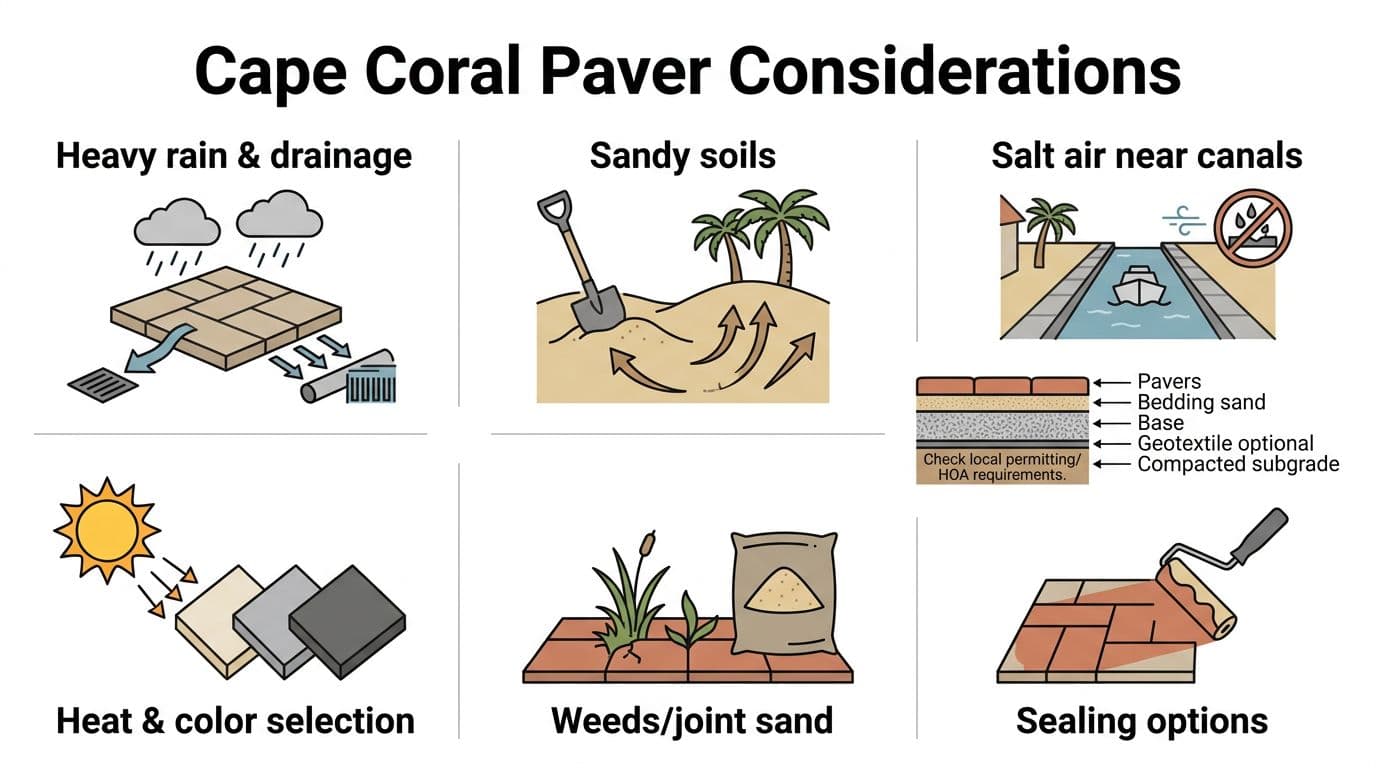 Local factors that affect paver performance, plus a simple layer diagram, created with AI.
Cape Coral surfaces deal with sudden downpours, sandy soils, and salt air (especially near canals). Those three factors can quietly decide whether your pavers stay flat.
Plan drainage first. Your paver pattern won't fix standing water. A gentle slope away from the home, plus smart runoff routing, matters more than a decorative border. If water sits, bedding sand can wash, joints can empty, and low spots grow over time.
Respect sandy soil. Sand can compact well, but it can also settle unevenly if the base is thin or poorly compacted. That's when you see little "waves" in patios and tire ruts in driveways. Strong patterns like herringbone help, but they still need proper base depth and compaction.
Salt air changes maintenance. Near the water, metal edging and some finishes can corrode faster. Ask what edge restraint system will be used, and how it holds up in coastal conditions.
Color affects comfort. Dark pavers can run hotter in direct sun. That's fine for a driveway, but it can feel rough on bare feet on a patio. Lighter blends often stay more comfortable while still hiding dust and leaf stains.
Finally, think about transitions. Many Cape Coral yards mix pavers with sod or artifical turf . A clean soldier-course border or a flush concrete curb can keep edges crisp where grass meets hardscape.
Borders, edge restraints, and repairs: where driveways usually fail
A good pattern can still fail at the edges. Most driveway problems start at the perimeter, then creep inward.
Use borders on purpose. Borders aren't only decorative. They "frame" the field and reduce edge movement. For driveways, a soldier course or contrasting border looks sharp, but the real win is control.
Edge restraints are non-negotiable. Without them, pavers slowly spread. Joint lines widen, sand washes out, and you'll see wobble at the edges. Restraints can be concrete, plastic, or other systems, but they must be anchored correctly and continuous.
Pattern affects repair speed. If you ever need to fix settling, run irrigation, or add a drain, a straight-lay field can be quicker to re-lay. Herringbone takes more care to stitch back cleanly, but it usually prevents the original problem (rutting) in the first place.
Maintenance matters too. Regular paver cleaning keeps joints from turning into little planters, and it helps you spot low areas early. Sealing can also lock joint sand in place and make spills easier to rinse.
If you're weighing repair versus replacement, it helps to understand typical ranges locally. See paver repair costs in Cape Coral for a realistic starting point.
Got a driveway quote from a concrete company instead? Use it as a comparison, but remember that pavers shine when you want easier spot repairs and more design control.
Talk to a contractor with confidence (quick checklist)
Use this checklist when you're getting estimates for a driveway or patio:
- Pattern choice : 45° or 90° herringbone for driveways, patio pattern selected for comfort and style.
- Paver thickness (driveway) : Ask for 80 mm pavers for vehicle areas (60 mm is common for patios).
- Base and compaction plan : What base depth will be used, and how will it be compacted for sandy soils?
- Drainage plan : Where will water go during heavy rain, and what slope will be built in?
- Edge restraints : What type, how it's anchored, and whether it's continuous around the perimeter.
- Joint sand type : Standard joint sand vs polymeric, and what's best for your site.
- Sealing plan : Whether sealing is recommended, and when it should be done after install.
A Cape Coral paver project should look good on day one and stay tight after years of storms and tires. Choose paver patterns for strength first, then dress them up with borders, color, and landscaping that fits your home.