


Invasive Plants to Avoid in Southwest Florida Front Yards
A pretty plant can become a weekly chore fast in Southwest Florida. One season of growth, rain, and heat can turn a neat front bed into a tangle that crowds sidewalks, swallows mulch, and spills into the lawn.
That is why southwest Florida invasive plants deserve attention before they hit your yard plan. Some are on Florida's invasive lists, while others are simply aggressive enough to cause nonstop trimming and cleanup.
Good landscaping in this region starts with plants that stay where you put them. The best front yards look relaxed, but they are built on choices that can handle sun, storm weather, and sandy soil without taking over.
What makes a plant a problem in Southwest Florida
Southwest Florida gives tough plants a lot of help. Warm winters, long rainy stretches, irrigation, and loose soil all make it easy for seeds, runners, and roots to spread.
Some plants are officially listed as invasive by Florida groups such as the Florida Invasive Species Council. Others are not as heavily regulated, but they still earn a spot on the "don't plant this" list because they outgrow small spaces, seed into neighbors' yards, or crowd out better choices.
If a plant fills the bed faster than you can prune it, it is already costing you more than it looks like it should.
Here is a quick scan of the plants that cause the most trouble in front-yard settings.
| Plant | How to spot it | Why it causes trouble | Better replacement |
|---|---|---|---|
| Mexican petunia | Purple trumpet flowers, narrow leaves, clumping growth | Spreads through roots and seed, even in tight beds | Britton's wild petunia or firebush |
| Brazilian peppertree | Glossy leaves, red berries, arching branches | Birds spread seed, and it forms dense thickets | Simpson's stopper or cocoplum |
| Chinese tallow tree | Heart-shaped leaves, pale waxy seeds | Seeds travel fast, and seedlings pop up everywhere | Wax myrtle or dahoon holly |
| Coral ardisia | Shiny leaves, red berry clusters under shade | Takes over shaded beds and spreads by birds | Coontie or wild coffee |
| Old World climbing fern | Lace-like fronds that climb fences and shrubs | Smothers plants and is hard to remove fully | Coral honeysuckle or crossvine |
| Australian pine | Tall trunk, needle-like foliage, heavy litter | Weak roots, storm risk, and poor fit for small lots | Sabal palm or another native accent tree |
| Chinese privet | Dense evergreen hedge, white flowers, black berries | Becomes a wall and spreads into nearby beds | Walter's viburnum or Simpson's stopper |
Plants to keep out of the front yard
Mexican Petunia
Mexican petunia looks harmless at first because the purple flowers are easy to like. The regular form and the dwarf form both show up in Florida nurseries, and both can spread far beyond the place you plant them.
The problem is the way it moves. It pushes through root growth, seeds into nearby areas, and slips into the edge of a lawn or drainage swale before you notice. Cutting it back often makes the clump look neater for a week, but it does not solve the spread.
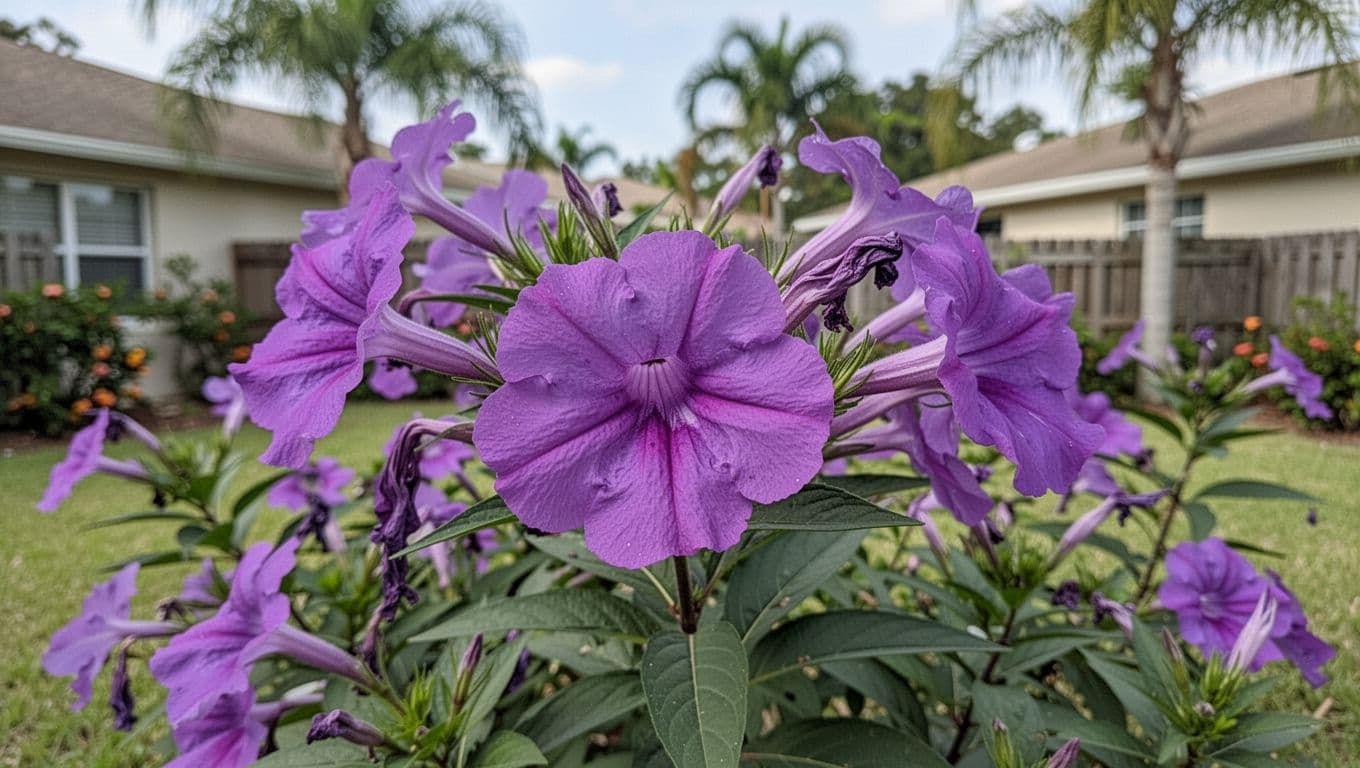
If you want a similar look without the takeover, try Britton's wild petunia or firebush . Both give color and stay more manageable in a front-yard bed.
Brazilian Peppertree
Brazilian peppertree is easy to miss when it is small, then hard to ignore once it fills in. It has glossy leaves, thin branches, and clusters of red berries that birds move around the neighborhood.
That berry spread is the real issue. In Southwest Florida, Brazilian peppertree can form thick growth along fences, in corners, and near vacant edges where it blocks light and crowds out other plants. Florida treats it as a serious invasive for good reason.
If you need a shrub with a clean shape, choose Simpson's stopper or cocoplum . Both fit better into a neat front-yard layout and do not turn into a bird-delivery system.
Chinese Tallow Tree
Chinese tallow tree is one of those plants that seems impressive until it starts seeding. It has heart-shaped leaves, a fast growth habit, and a fall color show that can fool homeowners into thinking it belongs.
The trouble starts when the white, waxy seeds show up. They drop, spread, and sprout in beds, ditches, and open spaces. In a small front yard, that means surprise seedlings and a tree that gets bigger than the space should allow.
For a more controlled look, use wax myrtle or dahoon holly . They give structure without the same level of escape, and they work well in Florida-friendly front-yard landscaping.
Coral Ardisia
Coral ardisia is a shade-lover, which makes it common under porches, trees, and side-yard edges. Its shiny leaves and red berry clusters can look tidy, especially in a nursery pot.
Once it settles in, though, it spreads under low light and fills space under larger shrubs. Birds carry the berries, so new plants can pop up in places you never intended. In a shaded front bed, that means more pulling and less control.
A better fit is coontie if you want a low, sturdy native plant, or wild coffee if you want a fuller shrub for filtered shade. Both handle Southwest Florida conditions without acting like a hidden ground invasion.
Old World Climbing Fern
Old World climbing fern looks delicate, which makes it easy to underestimate. It sends out lacy fronds that climb fences, hedges, and small trees, then spread over whatever they touch.
That climbing habit is the problem. It can blanket a front-yard planting bed, wrap around shrubs, and keep growing from small fragments. Florida lists it as a major invasive because it is so difficult to stop once it gets established.
If you need vertical interest, use coral honeysuckle or crossvine on a sturdy trellis. They give a softer climbing effect without turning your front yard into a green net.
Australian Pine
Australian pine is not a good front-yard tree for most Southwest Florida homes. It has a tall, rough trunk, needle-like foliage, and a habit of dropping a lot of litter.
The bigger issue is its structure and spread. It can be weak in storms, its roots are not friendly to tight spaces, and it has long been recognized as invasive in Florida coastal areas. In a residential setting, that means extra cleanup, more risk, and a tree that often outgrows the lot.
For a cleaner look, plant a sabal palm or another native accent tree that suits the space. The yard feels lighter, and the canopy does not fight the rest of the design.
Chinese Privet
Chinese privet is a classic example of a hedge that starts neat and ends up bossy. It makes dense evergreen growth, sends up white flowers, and produces berries that birds carry into other beds.
Homeowners like it because it looks full, but that fullness is exactly the issue. It crowds out smaller plants, shades the bed too much, and can turn into a wall that needs constant trimming. In front yards, that usually means more work and less shape.
A better hedge choice is Walter's viburnum or Simpson's stopper . Both can be pruned into a cleaner form and still leave room for the rest of the yard to breathe.
Safer swaps that still look polished
The easiest way to avoid invasive plants is to choose replacements with a job. Want color? Use firebush, Britton's wild petunia, or dwarf yaupon holly. Need a low screen? Simpson's stopper, wax myrtle, and Walter's viburnum are more reliable choices for Southwest Florida yards.
Hardscape also helps keep a front yard tidy. A concrete company can add clean edging or a small pad that keeps mulch where it belongs, while regular paver cleaning keeps walkways from looking worn out. In narrow, sun-baked strips where nothing grows well, artifical turf may make more sense than another thirsty groundcover.
If your front yard needs a bigger reset, professional landscape design and installation can turn a patchwork of problem plants into a cleaner plan that fits sun, drainage, and curb appeal. That matters even more when the old bed already has roots, runners, and leftover stumps to deal with.
Conclusion
The smartest front-yard planting choice is the one that stays manageable after the first rainy season. In Southwest Florida, that means skipping the plants that spread fast, seed hard, or outgrow a small bed before you can blink.
A good landscaping plan should make your home look cared for without turning into a maintenance trap. If a plant is invasive, aggressive, or simply too much for the space, the better choice is usually the one that gives you curb appeal and a quieter weekend.